 By Grant Mya
Looking Beyond Appearance
Rhinoplasty is often associated with changing the size, shape, or proportions of the nose. For many patients, appearance is an important reason for considering surgery. But the nose also plays a major role in breathing.
When its internal structure is narrowed, weakened, crooked, or damaged, airflow can become restricted. That may lead to persistent congestion, difficulty breathing through one or both nostrils, limited airflow during exercise, mouth breathing, or disrupted sleep.
Because of this, rhinoplasty can have both cosmetic and functional goals. The American Academy of Otolaryngology-Head and Neck Surgery notes that rhinoplasty may be performed for aesthetic reasons, functional reasons, or both. Depending on the cause of a patient’s symptoms, treatment may also involve the septum, nasal valves, turbinates, or sinuses.
Understanding those differences can help patients see nasal surgery as more than a cosmetic procedure. It can also help them recognize when another treatment may be more appropriate.
How Nasal Structure Affects Breathing
Air entering through the nose has to move through several naturally narrow areas. Even relatively small structural problems can make breathing more difficult.
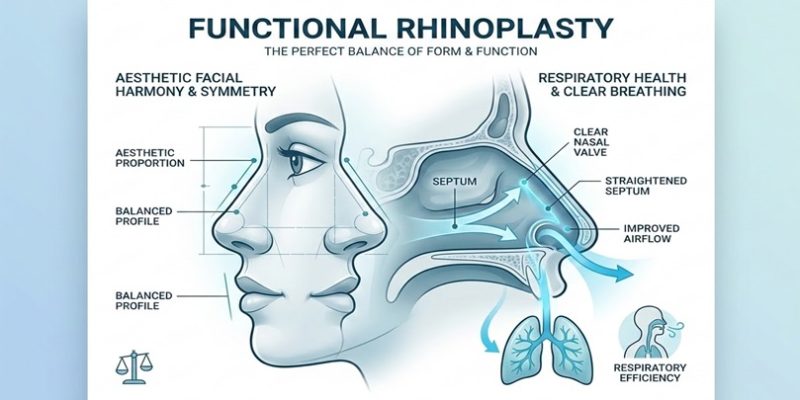
A significantly deviated septum, the wall that separates the nasal passages, may restrict airflow on one or both sides. The nasal valve can also become too narrow or collapse inward during inhalation. Enlarged turbinates, scar tissue, previous injuries, and other structural changes may add to the obstruction.
These problems aren’t always visible from the outside. Someone can have a nose that looks fairly straight while still experiencing substantial internal blockage. A visibly crooked or previously injured nose, meanwhile, may involve both external changes and airway problems.
The American Academy of Otolaryngology-Head and Neck Surgery notes that nasal valve repair may be performed on its own or alongside procedures such as septoplasty or turbinate reduction when more than one area contributes to nasal obstruction.
This is where the difference between cosmetic and functional rhinoplasty becomes important. Cosmetic rhinoplasty focuses primarily on appearance. Functional rhinoplasty is planned around airflow, structural support, or both. In some patients, those goals overlap.
Functional Rhinoplasty for Nasal Obstruction
Functional rhinoplasty is designed to address structural problems that interfere with nasal breathing. Depending on the patient’s anatomy, surgery may involve strengthening or repositioning cartilage, widening or supporting a narrowed nasal valve, correcting changes caused by trauma, or combining rhinoplasty with septal surgery.
Research using patient-reported outcome measures has found meaningful improvements in nasal obstruction symptoms after functional rhinoplasty. Results still vary based on anatomy, surgical technique, healing, and individual patient factors.
Patients considering rhinoplasty in Dallas may come across practices such as North Texas Facial Plastic Surgery, which provides cosmetic rhinoplasty and other nasal surgery services. Its published materials also discuss functional rhinoplasty, reflecting the importance of evaluating both external appearance and internal airflow when breathing concerns are present.
Someone considering functional nasal surgery in Dallas may want to ask how a proposed procedure could affect breathing as well as appearance. Breathing difficulty alone, though, doesn’t automatically mean rhinoplasty is the right treatment. The cause of the obstruction needs to be identified first. A deviated septum, nasal valve collapse, enlarged turbinates, chronic inflammation, or several overlapping conditions can produce similar symptoms.
The Septum, Nasal Valves, and Turbinates
A deviated septum is one of the most familiar causes of nasal blockage. Septoplasty is the procedure used specifically to correct a deviated septum, while rhinoplasty changes the framework or external shape of the nose. The two procedures may be performed together when a patient has both internal deviation and concerns involving the external structure.
The nasal valves also play an important role in airflow. Because this part of the airway is naturally narrow, even small changes in support can affect breathing.
Some people notice that the side of the nose collapses inward when they inhale deeply. Others find that breathing improves when they gently pull the cheek outward or use an external nasal strip. The American Academy of Otolaryngology-Head and Neck Surgery notes that improvement with this type of support may sometimes suggest that nasal valve or tip surgery could help.
Turbinates are another possible source of obstruction. These structures help warm and humidify incoming air, but inflammation and other conditions can cause them to enlarge. When enlarged turbinates contribute significantly to blockage and don’t respond well enough to medical treatment, a turbinate procedure may be considered.
The right treatment depends on knowing which structure, or combination of structures, is actually causing the problem.
Why an Airway Evaluation Matters Before Surgery
Nasal stuffiness, mouth breathing, reduced exercise tolerance, or the feeling that one side of the nose is constantly blocked can have several causes. A thorough airway evaluation may include a medical history, examination of the inside and outside of the nose, assessment of the septum and nasal valves, and consideration of allergies, inflammation, or sinus disease.
A patient looking for a sinus doctor in Plano for an airway evaluation may encounter this broader approach through an ENT practice such as North Dallas ENT. Its Plano location lists nasal, sinus, and sleep-related services, and its educational materials identify anatomical blockage as one possible cause of nasal airway obstruction.
This type of evaluation can help determine whether symptoms are primarily structural, inflammatory, sinus-related, sleep-related, or caused by several issues at once.
Matching the treatment to the cause matters. Surgery intended to support a collapsing nasal valve won’t treat an environmental allergy. In the same way, allergy medication can’t straighten a severely deviated septum. For some patients, effective care means addressing more than one contributor.
Nasal Breathing, Sleep, and Nighttime Symptoms
Nasal obstruction may become more noticeable at night. Lying down can worsen congestion for some people, while restricted airflow may encourage mouth breathing.
Patients may wake with a dry mouth, sleep poorly, snore, or simply feel that breathing through the nose is uncomfortable.
Research suggests that properly selected nasal surgery may improve subjective sleep quality and daytime sleepiness in some people with nasal obstruction. Its role in obstructive sleep apnea is more limited.
Reviews have found that isolated nasal surgery doesn’t consistently produce large improvements in the apnea-hypopnea index, a standard measure of sleep apnea severity. Some patients may still report easier nasal breathing or better perceived sleep quality.
The American Academy of Otolaryngology-Head and Neck Surgery describes nasal surgery as a potential adjunct to adult obstructive sleep apnea treatment rather than a stand-alone cure. Improving nasal airflow may also help some patients tolerate CPAP therapy more comfortably.
Anyone experiencing loud habitual snoring, witnessed pauses in breathing, gasping during sleep, or significant daytime sleepiness should discuss those symptoms with a healthcare professional rather than assuming rhinoplasty alone will address them.
When Allergies Contribute to Nasal Congestion
A blocked nose isn’t always caused by anatomy. Allergic rhinitis can lead to congestion, sneezing, nasal drainage, itching, and other symptoms when the immune system reacts to environmental allergens. The American Academy of Allergy, Asthma & Immunology notes that allergic rhinitis commonly causes a stuffy or runny nose and that treatments such as intranasal corticosteroids may reduce inflammation and congestion.
When symptoms change with pollen seasons, pets, dust, or other environmental triggers, an allergist or immunologist may help identify an inflammatory cause. West Hills Allergy & Asthma Associates describes common allergic rhinitis symptoms such as sneezing, nasal congestion, runny nose, itching, and eye irritation. Its materials also note that allergy testing may be used when identifying a specific trigger is important.
Allergies and structural problems can exist at the same time. Someone with an already narrow nasal passage may notice much worse breathing when allergy-related swelling develops.
In those cases, surgery may address the fixed structural narrowing while allergy treatment manages recurring inflammation.
That distinction is important for setting expectations. Rhinoplasty changes nasal structure. It doesn’t stop the immune system from reacting to pollen, dust mites, animal dander, or other allergens.
How Better Nasal Airflow May Affect Daily Life
Chronic nasal obstruction can affect more than breathing comfort. People who regularly breathe through their mouths may experience dryness or irritation. Others notice the restriction most during exercise. Poor sleep linked to ongoing congestion may also affect daytime energy, concentration, and overall well-being.
Studies of functional rhinoplasty and septal surgery often use patient-reported quality-of-life measures because anatomy alone doesn’t always capture how much nasal obstruction affects daily life.
A 2024 systematic review found evidence that functional rhinoplasty can improve quality of life. Other studies have also reported improvements in nasal obstruction scores after septoplasty and functional nasal surgery.
No procedure can guarantee symptom relief. Healing takes time, and several factors can affect the final result, including scar formation, persistent inflammation, untreated allergies, sleep disorders, and additional areas of anatomical narrowing. A careful preoperative evaluation is just as important as the surgical technique itself.
Seeing Nasal Symptoms as Part of Overall Health
Chronic breathing and sleep symptoms don’t always fit neatly within a single specialty. Structural nasal obstruction may involve an ENT or facial plastic surgeon. Allergy-related symptoms may require an allergist. Sleep problems may need a separate assessment. Other health conditions can also affect fatigue, sleep quality, recovery, and the way symptoms are experienced.
Coordinated care can be helpful when a patient’s concerns extend beyond the nose. For example, www.bluestonehw.com describes its services as including integrated primary care and behavioral healthcare. Primary care may provide another point of contact when symptoms such as fatigue, poor sleep, headaches, anxiety, or chronic medical conditions need to be evaluated alongside a more focused nasal complaint.
This broader perspective can be especially useful when someone expects one procedure to solve several unrelated symptoms. Improved nasal airflow may make breathing more comfortable and may contribute to better sleep in selected patients. But insomnia, obstructive sleep apnea, allergies, and other health concerns may still need their own treatment.
Matching the Treatment to the Cause
Rhinoplasty can do more than reshape the nose.
For appropriately selected patients, functional rhinoplasty may help correct structural obstruction involving the nasal framework. It may also be combined with treatment involving the septum, nasal valves, or turbinates when several areas contribute to poor airflow.
Research supports improvements in nasal obstruction and quality of life for many patients who undergo functional nasal surgery. Sleep-related benefits appear to depend more heavily on the individual and the underlying cause of the symptoms.
The most important step is identifying what’s actually causing the problem before choosing a treatment.
Structural blockage, inflammation, sinus disease, allergies, and sleep apnea can produce overlapping symptoms, but they require different approaches. A thorough evaluation can help determine whether rhinoplasty is appropriate, whether another treatment should come first, or whether several treatments need to work together.
When appearance and breathing are both concerns, looking at the nose as both an aesthetic feature and a functional airway can lead to better-informed decisions and more realistic expectations.